Thursday, May 12, 2011

No Gripe on Skype


Dr. Eric K. Clemons is a professor of operations and information management at Wharton, and a pioneer in the study of the transformational impacts of information on the strategy and practice of business.

Recently, Dr. Clemons weighed in on Microsoft's $8.5 billion takeout of Skype.
Although ClientWise is an executive coaching firm, and not in the business of providing investment advice, we found Dr. Clemons' comments to be insightful and illuminating...and wanted to share this interview with our subscribers.

Besides...most guys who sport bow-ties these days are worth a listen.

by Chris Holman

Tuesday, May 10, 2011

The State of the Financial Services Industry


There’s a pretty interesting interview with Chip Roame of Tiburon Strategic Advisors, who recently hosted the Tiburon CEO Summit, a semi-annual gathering of the renowned leaders and other muckety-mucks within the financial advisory industry.

Roame opines about some of the top industry trends:

Are the Wirehouses Alive, Dead, or Dying? (Alive and well, but how many advisors will they ultimately employ?)

Which Wirehouses are growing? (Of the four Wirehouses, only Wells Fargo has seen growth in advisor numbers. UBS America’s days seem numbered.)

Is the “Breakaway Broker” a real phenomenon? (Real…but not in mass numbers. Moreover, 80% of the advisors who leave the Wirehouses do so involuntarily.)

What’s the future of the independent broker-dealer? (LPL has lapped the field with 12,000+ advisors. For the smaller and mid-sized b/d’s, the future looks far less certain.)

What are the trends in consumer wealth? (Stocks have come back 50%+, housing prices haven’t.)

Is the advisory business generally healthy? (Extremely so. The trend is its friend.)

Speaking of the state of the industry, there was a somewhat engaging article in the April issue of Registered Representative, “The Myth of the Vanishing Advisor.” The article explores the health of the financial advisory industry from the standpoint of advisor population, i.e. given the demographic and retirement trends of the affluent, as well as the advisors themselves, will there be a shortage of financial advisors in the future?

One comment stood out for me. Stephen C. Winks, a Richmond, Va.-based management consultant for financial advisors, estimates that there are 17 million households with more than $100,000 in liquid investable assets. He goes on to say that if each advisor had about 200 clients, it would take about 85,000 advisors to serve the market, a fraction of the current population. (There are about 350,000 active financial advisors today.) “You can do the arithmetic very easily,” Winks says. “We've got way too many brokers.”

Not to quibble with Mr. Winks, but his calculations assume that all advisors, and advisory firms, have a homogeneity of skill sets and have been equally adept at staying current with some of the rapidly changing demands and expectations of the complicated financial lives of affluent investors.

From our vantage point, this is hardly the case.

by Chris Holman

Wednesday, May 4, 2011

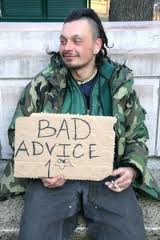
Advice


Most advice is terrible. So says Dr. Heidi Grant Halvorson, author and motivational psychologist, in a recent blog post of hers, “The Difference Between Good Advice and Bad Advice.” Dr. Halvorson goes on to say, “Whether you get it (i.e. advice) from a best-selling author, your boss, or your neighbor, nine times out of ten it’s about as useful as a screen door on a submarine.”

Dr. Halvorson is also the author of Succeed: How We Can Reach Our Goals; which is also kinda funny when you think about it. (Ironic? Paradoxical? Nervy?) Presumably, she doesn’t include herself in the 90% of advice-givers who are “terrible.”

Advice-giving is really big business, and completely recession-proof too. It is estimated that when one tallies all of the self-improvement training and paraphernalia, e.g. books, authors, seminars, holistic institutes, infomercials, etc., the total self-help market is more than a $12 billion industry, and growing at 6%+ annually. Indeed, when one enters “self-help” in the search box on the Amazon website, you’ll find 129,706 different books that fall into this ever-increasing category. (By Dr. Halvorson’s calculus, 116,735 of these books are valueless!)

What separates good advice from bad advice? One of the challenges with getting advice from others is that the advice often comes with strings attached. When you think about it, it is really difficult for many advice-givers, even well-intentioned ones, to dissociate themselves from their own personal agenda when they dispense their advice. In this way, their advice is more about them, and less about you.

As Oscar Wilde has said, “The only thing to do with good advice is pass it on; it is never of any use to oneself.”

The other interesting thing is that when one gathers advice from others, solicited or not, there is a tendency to discount our own intuition and experiences. Not that we shouldn’t value the insights of others, but sometimes the best solution to a specific problem can be found in our own backyard…by virtue of using our own built-in tools and instincts. Although I am no psychologist, it seems that sometimes when we seek advice from others, what we really want is their approval.

I’m curious. When was the last good advice that you received? On the other hand, when was the last time that you came to a resolution…intuitive leap of understanding…or clarity of thought, by your own thinking efforts? My guess is that, for many of you, the last circumstance was much more recent than the first.

On the matter of giving advice, I have always appreciated this quote from Harry S. Truman, when he offers this guidance on how to advise one’s children:

“I have found the best way to give advice to your children is to find out what they want and then advise them to do it.”

Interestingly enough, “advising them how to do it” is still giving advice, and an indicator of how tricky it is to break the advice-giving habit.

by Chris Holman

Thursday, April 28, 2011

"Traditional planning is just table stakes."


There was an interesting development yesterday, April 27th, in the competitive quest to serve affluent clients. U.S. Bank announced the launching of Ascent Private Capital Management, a new wealth-management group for high-net-worth clients with more than $25 million in assets.

In the words of Michael Cole, president of the unit, “These ultra-high-net-worth clients are unique and different. Traditional planning is just table stakes. We are already good at these things. We need to help them do more than just manage their wealth. We need to help them manage the impact of their wealth.”

The bank hopes that, by engaging affluent families in broader discussions about their values and goals, the new unit will help prevent the loss of wealth that often occurs as assets are transferred from one generation to the next. About 70 percent of all estates fail to transfer successfully to the next generation, according to a study by the Williams Group of Stockton, Calif. The primary reasons are poor communication and lack of trust, rather than bad advice or financial mismanagement, according to the study, which included interviews with 3,250 families over four decades.

The competition among banks that are targeting the high-net-worth market is intense. U.S. Trust is the purported leader among the group, all of who are chasing the 36,000 or so persons in North America with investable assets of $25+ million. With this latest move, U.S. Bank is trying to distinguish itself with what it refers to as “wealth impact” services, i.e. sophisticated advice on how the affluent can make a positive impact upon the world (as opposed to ho-hum services like traditional planning and wealth management)

by Chris Holman

Wednesday, April 27, 2011

Get the Upper Hand on Voicemail


Voicemail is a necessary evil for most of us today.

I wanted to pass along the comments of a Mr. Tibor Shanto, a self-proclaimed voicemail expert. (btw...this image is definitely not of Mr. Shanto.)

Although I would dismiss some of Mr. Shanto's assertions as sheer puffery, e.g. “50% of my voicemails are returned in 72 hours”, I actually like the way he frames up the entire communication environment that has led to the prevalence of the use of voicemail today.

His tips on how to leave a voicemail are on point too. He says his voicemails are just ten seconds long. They include:

• His name and company,
• His phone number (pronounced slowly),
• And a short, somewhat cryptic comment that piques curiosity and compels the recipient to call you back.

In this link (here) is a 10-minute YouTube video where Mr. Shanto talks at length on how to leave a voicemail. It’s definitely worth a listen if you'd like to brush up on your voicemail skills.


All the best!

by Chris Holman

Tuesday, April 26, 2011

Time, Money, & Happiness


Jennifer Aaker is a social psychologist, author, and professor of marketing at Stanford University's Graduate School of Business. Over the years, her research has focused on three topics of interest to most of us: Money, Time, and Happiness (not necessarily in that order).

Her big interest is in uncovering what actually makes people happy...as opposed to what they think makes them happy.

In this regard, she has recently co-authored an article in the Journal of Consumer Psychology, "If Money Doesn't Make You Happy, Consider Time".

As I read it, her conclusions can be summed up thusly:
  1. Happiness is a consequence of the choices we make.
  2. Time is a finite resource. We can increase our happiness by spending our time wisely.
  3. The more time that we spend with our partners, best friends, and close friends...the happier we are.
Sounds straightforward enough. How does one make this happen?

  • Spend time with the right people. Socially connecting activities are responsible for the happiest parts of the day. Work is an essential part of this element in the time-happiness relationship. Two of the biggest predictors of a person's general happiness are whether they have a 'best friend' at work...and whether they like their boss.
  • Spend time on the right activities. How much time during the day do we spend on mindless activities, where we never actually make the intentional choice to participate? It is better to ask the question, "Will what I am doing right now become more valuable over time?"
  • Enjoy experiences without actually doing them. The part of the brain responsible for feeling pleasure (the mesolimbic dopamine system) can be activated by merely thinking about something pleasurable. A great example: reading a guidebook before a much-anticipated vacation. [I think they call this "daydreaming"]
  • Focus on the present. Research has shown that focusing on the present (vs. the future) can slow down the passage of time. [One can do this by simply breathing more deeply.]
  • Happiness changes over time. Younger people (i.e. Millennials) experience happiness as excitement. Older folks (i.e. Baby Boomers) experience happiness as peacefulness. The implication is, as we age, that we should shift how we spend our time, as our understanding of happiness changes.
For financial advisors, we can draw interesting inferences from all of this. For example, "Spending time with the right people" should definitely include our clients. If we don't enjoy our clients as individuals, the days can become very, very long. Similarly, I also like the mindfulness of "Spending time on the right activities". Sometimes I feel that when I'm really tired, or a bit blue, I can go from activity-to-activity without even thinking about its value. The net result is that my mindlessness seems to exacerbate my ennui.

Cheers!

by Chris Holman

Tuesday, April 19, 2011

Your (Flawed) Telepathic Powers


Chris Brogan is an author, entrepreneur and thinker. His blog, chrisbrogan.com, is in the Top 5 of the Advertising Age Power150.

In a recent post, “Mind Reading”, he discusses the human tendency to project our thoughts (and fears) of what we perceive someone else is thinking…and make mental presumptions that constrict our behaviors.

Example: You have a good friend who you believe would be a terrific client and one who would greatly benefit from your services...even though you have never actually broached the idea of working together. The voice in your head says,
“I’d love to work with them, but I’m sure that they wouldn’t want to discuss this because they are most likely working with someone else.”

The interesting thing about mind-reading is that we all do it...
including your good friend!

To follow the above example, it is entirely possible that your friend has a professional issue that they’d like to discuss with you because they really, really trust you. However, they don’t because they have their own voice that is playing in their head saying,
“You know, I’d really like to talk to him/her, but I don’t think that I’m the sort of client they’re looking for.”

(This is actually not a far-fetched example. From our research, this happens fairly often where potential clients do not reach out to professionals who they know and trust, because they think that they, i.e. the potential client, does not meet the minimum standards that the professional might require.)

Brogan goes on to say that it's important to stay vigilantly self-aware against "mind-reading". If not, we run the risk of manufacturing these conversations in our head that are more perception than reality. Most likely, these perceptions are incorrect or not wholly true...especially if they are negative.

It would be a shame to live a life of relationships that never happened because of imaginary conversations that convey perceptions that never actually existed.

On another completely unrelated note.

Yesterday, Joan Benoit Samuelson ran in her first Boston Marathon in 18 years. Previously, she had won the race in 1979 and 1983. At 53 years old, Ms. Samuelson had hoped to qualify for the U.S. Olympic trials by finishing in 2:46:00 or better.

She didn't make it. Not this time. However, she finished in 2:51:29...the 45th fastest time among all women who ran the race.

For those of you who have ever run a marathon, you know that 2:51 is a super-quick time. To do this at 53 years old is a stunning and inspirational feat...especially for those of us on the north side of the half-century mark.

Thank you Joan!

by Chris Holman

Tuesday, April 12, 2011

Decamillionaires Need Your Help!


There’s a famous, and most likely apocryphal, exchange between Ernest Hemingway and F. Scott Fitzgerald:

Fitzgerald: “The rich are very different from you and I.”

Hemingway: “Yes. They have more money.”

They may be different in another way. They have more advisors.

According to recent research from Cerulli Associates, 57% of U.S. households with at least $10 million in investable assets are now working with five, or more, financial advisors.

This is a shocking number! Almost impossible to believe. It's also a quantum leap from previous years. For example, in 2008 only 18% of wealthier households were working with more than one advisor.

What accounts for this increase? For financial advisors here's the bigger question...how might they respond to this trend?

In the first place, the 57% figure is such a mind-blowing number, you wonder if this is a mistake...some egregious polling error. However, I recently saw another report by Cisco Internet Business Solutions Group that indicated 80% of wealthy investors had their assets spread amongst 2 or more firms.

So, let’s assume that the 57% number has some statistical validity.

I’ve blogged about this before, here…and here. However, since the problem seems to be getting worse, not better, continued discussion seems timely.


Let's look at the first question. What accounts for the increase in affluent investors who have moved to working with multiple advisors?

The most obvious answer is that there has been an erosion of trust and confidence. The volatility in the credit, stock markets, US economy has made it more difficult for the wealthy to manage their wealth, maintain their lifestyle, and achieve their goals. Presumably, the move to hire multiple financial advisors is the result of a desire to minimize risk.

The great irony is that, by working with multiple advisors, investors greatly increase portfolio risk...as well as the overall complexity of portfolio oversight.

Take a look at this study for a lengthy discussion of why this is true.

For financial advisors, the bigger question is how to respond, i.e. when you meet an investor who is involved in bad investment behavior that is injurious to their financial health...what do you say or do to get them to listen?

Alternatively, I would think that a non-judgmental, question-based approach that engages the investor in dialogue, and gets them to think about what they're doing...is a good shortcut to building a relationship.

Simple questions like:
  • Who is responsible for your asset-allocation strategy?
  • How do your advisors coordinate and collaborate with each other?
  • What's the communication plan amongst all of your advisors...and you?
  • How do you prevent portfolio overlap?
...might go a long way to building a relationship of confidence and trust; and leading to more substantive conversations.

by Chris Holman


Tuesday, April 5, 2011

"Talkin' 'bout my generation..."


People try to put us d-down (Talkin' 'bout my generation)
Just because we g-g-get around (Talkin' 'bout my generation)
Things they do look awful c-c-cold (Talkin' 'bout my generation)
I hope I die before I get old (Talkin' 'bout my generation)

"My Generation", written by Pete Townshend and performed by The Who, was named the 11th greatest song of all time by Rolling Stone. The song, composed by Townshend at the age of twenty because he was infuriated at the Queen Mother for allegedly having his car towed, was written for rebellious British youths and expressed their feeling that older people "just don't get it".

In a recent study by Cisco Internet Business Solutions Group, "Winning the Battle for the Wealthy Investor", some key findings reveal the same response. However, in this case it's the financial advisors who "just don't get it".

Among the interesting observations of the study was the attention paid to Wealthy Investors Under the Age of 50, a client segment that many financial advisors tend to ignore. Key characteristics of the Wealthy Under-50's demographic include:
  • Hold 28% of the wealth in the US,
  • Have higher incomes than older investors, and more likely to own their own business,
  • 67% expect a substantial windfall/inheritance within the next ten years.
However, the study also reveals a "Generation Gap" when comparing how the Wealthy Under-50's expect to be served by their financial advisor:
  1. Wealthy Under-50's are looking for a "custom fit", including financial services tailored to their specific investment needs, and a range of options for interacting with their financial advisor,
  2. Wealthy Under-50's spend more time managing their investments and want to interact more frequently with their advisors,
  3. Wealthy Under 50's appear to be "restless" with their financial services firms that cannot deliver they type of client interactions that they want, e.g. they desire faster and more convenient options for interacting with their advisors and firms...beyond in-person meetings, phone conversations, and email.
It is this last point, the % of wealth US investors interested in using different technologies, where the Generation Gap is most apparent:
  • 54% of Wealthy Under-50's are interested in webcam conferencing vs. 21% of Wealthy Baby Boomers,
  • 59% of Wealthy Under-50's are interested in screen sharing vs. 32% of Wealthy Baby Boomers,
  • 56% of Wealthy Under-50's are interested in HD video from home/office vs. 24% of Wealthy Baby Boomers.
Switch Advisors?
Indeed, one of the somewhat shocking revelations of the study was that a full 63% of Wealthy Under-50's would seriously consider moving their assets to another firm in order to gain access to these new communication technologies.

We are always a little suspicious of study results that indicate an investor's hypothetical intention to move their assets. (We recall a post-meltdown study in 2008 or so, where 70%+ of investors said they were so hacked-off at their advisor that they planned to switch firms. Never happened!)

Nonetheless, many of the findings of this study ring true concerning the generational difference that exists among the Wealthy Under-50's Investor, especially with regard to technology, and how they expect their financial advisor to connect with them with newer, high-touch, faster, interactive, and more collaborative mediums.

The industry is forewarned.

PS: The study also highlighted another opportunity for financial advisors, i.e. wealthy investors of all ages who have their assets with multiple advisors. In the next day or so, we'll address this too. Stay tuned...

by Chris Holman

Tuesday, March 29, 2011

"You have everything you need to build something far bigger than yourself."


Seth Godin knows how to craft a good quote.

“Leadership is about finding the right people, agreeing where you want to go, and getting out of the way.”


"Faith in yourself, in your friends, in your colleagues and most of all, faith in your ability to impact our future is the best strategy I know.”


"Leadership is saying what you believe, and seeing who follows.”


Seth Godin is an entrepreneur, blogger, author (16 books at last count), and marketer-extraordinaire. His blog, Seth’s Blog, has been ranked in the AdAge Power 150 as the #1 marketing blog. (It is currently ranked #22.)

With a double major in computer science and philosophy, and a Stanford MBA, Seth Godin brings a rich and balanced perspective to leadership and business issues.

Godin coined the phrase “permission marketing.” As opposed to “interruptive marketing”, “permission marketing” is where the prospective client grants explicit permission for the marketer to send their promotional message. Permission marketers feel that this is a more efficient use of their resources because offers are only sent to those people who are actually interested in their product or service.

Godin is an insightful thinker and thought-leader. In a recent blog entry, he discusses the concept of accepting false limits. He says, “I don't accept for a minute that there's some sort of natural limit on your ability to do just about anything that involves creating and selling ideas.”

In this recent video, Godin expands on some of his leadership philosophies. There are some very good observations here…applicable to all entrepreneurs and leaders…and well worth the 7-minute listen. (Please ignore the annoying background music.)

“Hope without a strategy doesn’t generate leadership. Leadership comes when your hope and your optimism are matched with a concrete vision of the future and a way to get there. People won’t follow you if they don’t believe you can get to where you say you’re going.”...Seth Godin

by Chris Holman

Tuesday, March 22, 2011

"You define yourself by what you can do, not what you can't!"


You may have noticed the mythic tale of Anthony Robles, born without a right leg, who won the NCAA 125-pound wrestling championship over the weekend.

More complete stories of his heroically epic story can be seen here and here. What caught my eye was something this young man said:

“You define yourself by what you can do, not what you can’t.”

This reminds me of an excellent essay that I once read by Marshall Goldsmith, the author and executive educator, “Change the Way You Define Yourself.”

Goldsmith says that we all have characteristics and behaviors that we use to define who we are. On the success side, we might describe ourselves as, “intelligent”, “results-oriented”, or “persistent”. On the not-so-success side, we all have some self-definitions that frame us in a negative light, e.g. “stubborn”, “opinionated”, or “inflexible”.

Goldsmith points out that one of the greatest challenges that we face, when seeking to improve ourselves, is the challenge of changing the way that we define ourselves.
We do this by pigeonholing ourselves with absolute characteristics and say, “That’s just who I am”, or “It is what it is”.

The problem becomes that we use “That’s just who I am”, as a rationale NOT to change…even when change is desirable and possible.

As Goldsmith goes on to say, unless a behavior is shaped by genetic preconditions (born that way) or environmental factors (external factors that prohibit us from changing), very few behaviors are immutable to change…should we have the motivation and desire to do so.

And as Anthony Robles has demonstrated, sometimes “genetic preconditions” can’t stand in our way either!

by Chris Holman

Thursday, March 17, 2011

Crisis in Japan


Although the horrific crisis in Japan seems to be unfolding by the hour, we wanted to pass along this collection of interviews (dated 3/16/2011) from four experts, all who happen to be professors at the Wharton School.

"Crisis in Japan: What will the costs be?" addresses this event from three perspectives: the economic costs, crisis planning, and the global impact.

This is content-rich, with more than 60 minutes of informative discussion, and provides a good context for understanding the future global implications. You might also want to download a pdf of the entire interview to review at a future time.

by Chris Holman

Tuesday, March 15, 2011

Big Hairy Audacious Goals


On this date, 15 March 44 BC, Julius Caesar was assassinated. Caesar was the Roman general who was too successful in achieving his “Big Hairy Audacious Goal” of centralizing his dictatorial power within the Roman Empire.

2040 years later, James Collins and Jerry Porras first proposed the term Big Hairy Audacious Goal (BHAG) or Bee-Hag in their 1996 article entitled Building Your Company's Vision. In the article, the authors define a BHAG as a form of vision statement, "...an audacious 10-to-30-year goal to progress towards an envisioned future."

“A true BHAG is clear and compelling, serves as unifying focal point of effort, and acts as a clear catalyst for team spirit. It has a clear finish line, so the organization can know when it has achieved the goal; people like to shoot for finish lines.”

In the authors’ view, BHAG’s are a powerful mechanism for highly visionary companies to stimulate progress, and stay on top. One of their corporate examples was that of Boeing in the 1950’s. At the time, Boeing had no presence in the corporate market; 80% of their business had been with one client…the US Air Force. All previous commercial attempts had been failures.

In Boeing’s case, they bet the company (one-quarter of their corporate net worth) on building the prototype for a jet. In 1957, on a rainy day in Renton, Washington, the first 707 flew off into the clouds and revolutionized commercial travel by introducing the “jet age”. Competitors, like Douglas Aircraft, never caught up.

When organizations set goals, BHAG’s are seen as an important element in setting a high-performance culture. By setting extremely ambitious targets, it can cause one to think creatively about achieving these goals, and be energized and motivated to move the organization forward.

There is an art to setting stretch targets. On the one hand, research has shown that having some anxiety about the achievement of a goal is a good thing. However, goals that are set arbitrarily, without the participation of all who are expected to work toward this end, can be problematic. Moreover, goals must be realistic. If one doesn’t believe that a goal is attainable, the entire exercise can be counter-productive, and possibly demotivating.

To Tame Your BHAG, Try This

  1. Exhibit courage, and a willingness to take on risk. Even small increases in productivity can have profound, knock-on effects.
  2. For teams, build the confidence of the team-members to embrace the new reality...breaking through self-imposed limits and expectations.
  3. Increase team involvement to raise the bar. Leaders should be clear about expected outcomes, but allow employees the freedom to decide how the tasks are implemented.
  4. Follow through and stay the course. Don’t shift priorities each week, or each month.
  5. Identify, and emulate, peak performers.When high performers are not recognized or rewarded for exceptional effort, overall performance often declines.
  6. Utilize the support that emanates from team dynamics. Indeed, among some teams goals become overly ambitious and must be scaled back.
  7. Improve processes. Great teams, and great leaders, lower the process barriers.
  8. When a lofty goal is met, celebrate and reward.
On a cautionary note, not all attempts to best the BHAG are successful. In 1999, Durk Jager, a manager with a reputation for ruthlessness, ascended to the CEO throne at Procter & Gamble. Jager was known for his motto, "If it ain't broke, break it!" Jager announced job cuts that amounted to 15,000 in job losses, tore up the company's multi-layered bureaucracy, and pushed "stretch goals" on all employees. Eighteen months later, P&G had missed profit forecasts on three separate occasions...and had lost $75 billion in market value. In hindsight, Jager had pushed P&G, a company with a corporate culture that was somewhat risk-averse and inbred, too far and too fast.

"The greater danger for most of us lies not in setting our aim too high and falling short, but in setting our aim too low, and achieving our mark."...Michelangelo

by Chris Holman

Thursday, March 10, 2011

Closing the Loop Builds Trust


There’s a good reminder from a recent blog by Jodi Glickman on the importance of “closing the loop”. Ms. Glickman is a speaker, author, and blogger for Harvard Business Review. In a recent post, “The Biggest Mistake People Make After Receiving a Favor”, she describes the importance of the last step in the asking-for-a-favor process…closing the loop.

“The right way to close the loop is simple: no matter the outcome, no matter if the news is good or bad, be sure to follow up and share what happened. Don't leave someone hanging after they help you out, wondering about the outcome. It's rude, it looks bad, and it actually has the potential to create negative consequences.”

Sound advice!

We see this, on occasion, with financial professionals who ask for referrals from their clients, friends and acquaintances. (Actually, we have observed that “asking for referrals” is not the best way to get referrals…but that’s a topic for another time.)

For financial professionals who receive referrals, it is fundamental that one “closes the loop” and share what happened with the referring source. As Ms. Glickman points out, it’s discourteous and incredibly bad form if one doesn’t follow this protocol, but there is another vitally important reason to do this.

Closing the loop demonstrates that you have follow-through skills. Most importantly, following up builds trust.

In the referral dynamic, the referral source has taken some personal risk by opening a small piece of their network to a financial professional when they provide a referral. Regardless of the eventual outcome of the referral, financial professionals build trust with referring sources by simply letting them know that the contact has been made. Indeed, studies have shown that one of the main reasons that referral sources stop providing referrals is for this very reason; they get left in the dark as to what actually happened, and whatever trust they had in the financial professional in the first place…quickly dissipates.

Speaking of the referral process, our proprietary research indicates that financial professionals have some gaps of their own. In a recent survey of top-performing financial advisors, 90% admitted that they do not have a clearly-defined referral strategy, and 87% indicated that they do not track where their referrals come from.

Summing this up, for most successful financial advisors, referrals are the #1 growth driver for new business. The likelihood of receiving referrals is greatly enhanced by having a process, which includes seemingly innocuous steps like...closing the loop.


On another completely different note, Happy March 10th! It was on this day in 2000…that the NASDAQ hit an intra-day high of 5132.52.

Seems like just yesterday…not!

by Chris Holman

Monday, February 28, 2011

Buffett Bullish on America


As you Buffettologists already know, Warren Buffett released his annual shareholder letter over the weekend. By word and deed, he seems quite optimistic on the future course of the US from an investment vantage point.

Since Mr. Buffett is his own best communicator, I’ll let him speak for himself:

"Money will always flow toward opportunity, and there is an abundance of that in America. Commentators today often talk of “great uncertainty.” But think back, for example, to December 6, 1941, October 18, 1987 and September 10, 2001. No matter how serene today may be, tomorrow is always uncertain.

Don’t let that reality spook you. Throughout my lifetime, politicians and pundits have constantly moaned about terrifying problems facing America. Yet our citizens now live an astonishing six times better than when I was born. The prophets of doom have overlooked the all-important factor that is certain: Human potential is far from exhausted, and the American system for unleashing that potential – a system that has worked wonders for over two centuries despite frequent interruptions for recessions and even a Civil War – remains alive and effective.


We are not natively smarter than we were when our country was founded nor do we work harder. But look around you and see a world beyond the dreams of any colonial citizen. Now, as in 1776, 1861, 1932 and 1941, America’s best days lie ahead.
"

Buffett as a Leader

Although Buffett's reputation was built on his sage investing prowess, his leadership has always been equally perceptive. Indeed, his investing success is a function of his ability to pick great managers, and trusting their judgment.

His holding company, Berkshire Hathaway, has 76 different operating units…from Burlington Northern Santa Fe, to GEICO, to See’s Candies. As a leader of his businesses, Buffett is notoriously hands-off. Every two years he sends out a letter to his 70+ managers that says a variation of the following:

  • Run this business like it’s the only business that you and your family can own over the next 100 years,
  • Don’t measure your success by quarterly earnings,
  • Measure your success by whether or not the moat around your business, that which gives you the competitive advantage, has widened or narrowed.
Berkshire's annual shareholder meeting, "Buffetpalooza", will be held on April 3oth, at the Qwest Center in Omaha.

by Chris Holman

Tuesday, February 22, 2011

How to Find Awesome Interns


When it comes to summer internships, an internship at Google is pretty much at the top of the totem pole. Google interns get nearly everything that full-time employees get, e.g. free cafes, a gym, a basketball court, recreational classes in yoga and salsa dancing, etc.

Being an intern at Microsoft isn’t bad either: free pizza and clothing, a Cirque du Soleil show, an engraved Zume digital media player, and a complimentary Windows 7 phone.

How do smaller businesses and entrepreneurs such as financial advisory practices compete with these glittering heavyweights?

Pretty good article from Nathan Parcells of Internmatch.com provides some insight. His #1 tip is to be proactive. Go directly to local colleges and universities. Get to know department heads and the career guidance office. Make your pitch at entrepreneurship classes and networking events. Above all else, find your “campus evangelists” who can refer peers and classmates.

There’s some more good information on the Financial Planning Association website. Author and mover-and-shaker Deena Katz advises that if you plan to use an intern as a go-fer doing grunt work, you risk creating a disillusioned young employee who may be forever turned-off with the financial services industry. Know exactly what you are interviewing for. If it’s a career path, or a summer internship only, let the intern know exactly the kind of experience that they’ll receive.

Also, you get what you pay for. If you expect professional ethics, professional dress, and expect the intern to take the job seriously, you'll need to compensate them accordingly. Depending upon their skill-set and where you are located geographically, a range of $12-20 per hour should be anticipated.

Finally, appreciate the subtle difference of working the Millennial generation. Millennials (born between 1980-2000) generally expect structure, guidance, and leadership…as well as continual challenges. Nice article here that offers 11 Tips for Managing Millennials.

Hope these tips help in finding a great summer intern.

Who needs some lame Microsoft t-shirt anyway?

by Chris Holman

Wednesday, February 16, 2011

Building Your Value Proposition: It's Not About You


In the book, Creating & Delivering Your Value Proposition, authors Cindy Barnes and Helen Blake define a Value Proposition as:

“ …a statement of the way a business proposes to deliver superior value to its customers by harnessing all of its resources in a profitable way.”

Using this definition, it is clear as to what a Value Proposition is...and is not. It is not:

  • An Elevator Pitch,
  • A Messaging Piece,
  • A Benefits Statement, or
  • A Unique Selling Proposition (USP)

A Value Proposition is, far and away, a stake-in-the-ground strategy whereby a company definitively outlines how they will deliver “superior value” to their clients.

After a company arrives at this strategy, they can build the Elevator Pitches and the other ancillary declarations that are described above. But the Value Proposition comes first.

Unique...or Not Unique?
One of the interesting questions for financial advisors is…how do I make my Value Proposition unique? After all, FINRA reports that as of January 2011 there are 630,847 licensed and registered representatives. Not all of these folks are on the front lines, of course. An estimate of financial advisors who actively serve clients is more likely to be half this amount…300,000+ or so would be an educated guess.

Moreover, many of the 300,000+ financial advisors have very similar offerings in their product/service mix, which further complicates the matter of arriving at a Unique Value Proposition.

It's Not All About You
To make it more likely that one builds a Value Proposition that is unique and differentiating, here’s a hint. Consider your clients first…assume that value can only come from the client’s perspective.

Before you do anything else, consider the buyer landscape and ask these questions:

  1. Who are my ideal clients?
  2. From their perspective, what is their value experience from a quantitative perspective?
  3. From the client’s perspective, what is their value experience from a qualitative perspective?

By asking these questions that focus on the client at the outset, financial advisors can go a long way to building a Value Proposition that is differentiating, if not unique. This is especially true if the ideal client niche is well defined. The more narrow the client niche, the easier it is to build a Value Proposition that differentiates.

One last point. When building a Value Proposition, although uniqueness is nice, clarity is best. Many financial advisors have built great businesses that stem from crystal-clear Value Propositions that are specific and easily understood….but aren’t terribly unique.

Conversely, the side-of-the-road is littered with “Unique” Value Propositions that are indistinct, vague and ill-defined.

by Chris Holman

Thursday, February 10, 2011

Clients As Partners


There's a compelling article in the Wealth section of today's NY Times entitled, The Hands-On Investor: Increasingly, Advisors Want Clients to Share the Responsibility of Managing Their Assets.

I have a quibble with the headline...which I'll get to in a minute.

But, I completely agree with the headline's implication. Our research corroborates as much. Top-performing financial advisors report to us that there is an ongoing shift in how some clients (not all) would like to work with them. This new dynamic emphasizes the partnership that is created, where the advisor and client build a collaborative space of working together to achieve the client's goals (which have been arrived at through an honest, thoughtful, and comprehensive dialogue between advisor and client). The key words here are "partnership" and "collaboration".

Interestingly, I don't find the words "partnership" or "collaboration" at all in the Times article...which seems unusual.

My quibble with the headline is the wording..."Advisors want clients to share the responsibility..." What the headline misses is that, in many cases, it's the clients who are driving this. They want to share the responsibility and accountability.

Of course, this makes complete sense when you consider how Baby Boomers make decisions. As the private individual wealth in this country has passed to the hands of the Boomer, financial advisors are seeing that Baby Boomers have different expectations of their advisor relationship than their parents did, the Silent Generation. With the old dynamic, the financial advisor could get away with portraying themselves as the all-knowing, all-seeing expert who dispensed advice from the mountain-top.

That approach doesn't work today. Many clients expect a much flatter relationship with their financial advisor, where their opinions, concerns and desires are valued and respected.

Ultimately, I think this new accountability is a good development for both advisor and client.

I'd be curious about your views on this...either as a financial advisor, or as a client.

All the best!

by Chris Holman

Tuesday, February 8, 2011

Linking Passions with Business Success


When I coach five ClientWise clients in one week who are all improving their business success using the same strategy, it merits a mention. These clients are all in different markets and have different strategies, but each one has an avocational passion. Advisors work very hard and spare time is at a premium, so why not combine business and non-business passions? In our discussions we strategized how to combine their outside-of-work love with their business development goals.

  • One client was recently elected to a national organization of wine connoisseurs. He is now undertaking a strategy to reach out to members of the organization in other regions so he can expand the reach of his relationships. His approach is not one of soliciting business just because someone belongs to the same club, but rather getting to know people with a similar interest in other markets, for the joy of it as well as for the business benefit.
  • Another client is a baseball fanatic and memorabilia collector. He's redecorating his office to bring in aspects of his personal life -- when prospective clients visit he wants them to experience not just what he does, but who he is. His assistant gave him a gift of a baseball signed by Tony Conigliaro, the Boston Red Sox legend, which now sits on his desk. The gift brought up a creative spurt as he thought about sharing the story of Conigliaro and how it relates to his clients' need to prepare for unforeseen circumstances.
  • The third client I spoke with is a Crossfit enthusiast. Rather than targeting new client prospects by income demographics, he's getting more involved in his Crossfit gym and is reaching out to members who he believes will be as interested in protecting their financial health as their physical well-being.
  • The fourth client loves classical music and enjoys taking clients to the symphony. Turns out he knows a board member at a music conservatory in his market. His goal is to get involved, get to know the other powers that be, and ultimately become a board member himself.
  • The fifth client is a tennis enthusiast. He hasn't put his business together goals with his passion yet -- but he’s going to. We came up with a couple of ideas to get started. Among the things he could do:
  1. Organize a tennis match for charity
  2. Organize a group coaching session(s) for small groups or individuals
  3. Conduct wealth seminars at tennis clubs and draw analogies between tennis and investing

As a coach, I would ask the following....are you using your passion to develop business?

Leave a comment. I'd love to hear how you are doing it.

by Mitch York

Thursday, February 3, 2011

Michael Lewis Gets Dupped!


I just caught an interview between author Michael Lewis, (Liar’s Poker and The Big Short) and Yahoo! Finance’s Daniel Gross and Henry Blodget.

Under the headline, “My Merrill Lynch Broker Screwed Me So I Fired Him and Switched to Schwab”, Lewis tells a personal story that involves owning some Lehman preferreds and Auction Rate Securities in his retirement account, having these exotics blow up, getting really irritated with his advisor, and closing his account at Merrill and transferring to Schwab.

As one listens to the interview, a number of different graphics pop up underneath their talking heads:

Beware of Wall Street Advice!

Dealing with Wall Street’s Conflict of Interest!

Don’t Listen to Brokerage Advice!

Ouch! Between the headline and the graphics, it’s not too hard to figure where this interview is going.

I certainly don’t want to be an apologist for Merrill Lynch or any other firm that got caught with their hand in the exotic derivative cookie jar. Yet, a number of points about this interview caused me to arch my eyebrows:

  1. In the first place, it’s the height of irony that Henry Blodgett participated in this. For those of you who don’t know Henry Blodget, read this Wikepedia entry. Given his own tortured history with conflict of interest, you’d think he would have had the common sense and good grace to recuse himself from this session.
  2. During the interview, Lewis says that he doesn't like being "sold". I don’t know what transpired between Mr. Lewis and his advisor. But in Liar’s Poker, Lewis recounts his antics as a bond salesman with Salomon Brothers in the 1980’s. Regarding the inherent risk of these particular securities, don’t you think he would have known? And don't you think that he'd know when he was being "sold"?
  3. The headline of the piece, “My Merrill Lynch Broker Screwed Me…” has a pretty dastardly implication in my mind. “Screwed” is a loaded term. Yet, when I listen to the interview, I don’t get the sense that Lewis was “screwed.” Although there may have been some willful ignorance involved, on the part of the advisor and Mr. Lewis…“screwed” seems to be a word that was inserted for the purpose of attracting eyeballs to the headline. I guess it worked.
  4. Finally, Mr. Lewis has an interesting take on what has happened to the advisory industry over the years. In his own words “The big firms have evolved since the 1980s, away from servicing the customer and maintaining nice, happy relations with the customer to managing friction with the customer on behalf of the firms’ traders.” In this case, he’s wrong…plain and simple. There is definitely an evolution that is happening within the brokerage firms, but it’s not this at all. It shows me that’s he’s pretty out of touch.
One last thing. My favorite graphic during this whole interview was, “How Big Short Author Michael Lewis Got Dupped by Wall Street.”

“Dupped”? What’s “dupped”? Do they mean “duped”?

Where’s the spell check? Where’s the editor?

That’s all for now. I’m done.

Have a nice day!

by Chris Holman

Monday, January 31, 2011

Norman Mailer and the Discipline of Writing


Today, January 31st, is the birth anniversary of Norman Mailer… a “towering writer of matching ego” as his NY Times obituary read.

Mailer was prolific as a writer, and other things. Since the 1948 publication of The Naked and the Dead, he published 30 books, wrote untold numbers of short stories, essays, and plays, was married 6 times, had 9 children, received 2 Pulitzers and 1 National Book Award.

His first novel, The Naked and the Dead, was published as a 25-year-old literary novice. The NY Times book critic called it “the most impressive novel about the Second World War that I have ever read.” Mr. Mailer saw little combat in the war and finished his military career as a cook in occupied Japan. But his wartime experience, and in particular a single patrol he made on the island of Leyte, became the raw material for “The Naked and the Dead,” the book that put him on the map. The book sold 200,000 copies in just 3 months…an astonishing amount in those days. It was on the NY Times bestseller list for 11 consecutive weeks.

The Writing Discipline
Mailer said, “Being a real writer means being able to work on a bad day.” Mailer stuck to a strict writing regimen. He said: "Over the years, I've found one rule. It is the only one I give on those occasions when I talk about writing. A simple rule. If you tell yourself you are going to be at your desk tomorrow, you are by that declaration asking your unconscious to prepare the material. You are, in effect, contracting to pick up such valuables at a given time. Count on me, you are saying to a few forces below: I will be there to write."

He wrote daily from 9 to 5, up until his death at the age of 84. For the last 27 years of his life, he shared a studio with his sixth and last wife, Norris Church Mailer, an artist and writer. They each had their own space. Mailer sat on a wooden chair looking out at the Provincetown Bay — he liked to be near water when he wrote — but he closed the curtains when he really needed to concentrate. Mailer and his wife ate breakfast and lunch on their own schedule, but they would meet up at 6 p.m. to drink wine and eat dinner.

In an interview in 2007, months before his death, Mailer said…“I think the novel is on the way out. I also believe, because it’s natural to take one’s own occupation more seriously than others, that the world may be the less for that.”

by Chris Holman

Thursday, January 20, 2011

Ask Not!


Fifty years ago today, January 20, 1961, President John F. Kennedy delivered his only inaugural address. The address was among the shortest inaugurals ever presented…just 1364 words…and took 14 minutes from start-to-end. However, American Rhetoric magazine recognized this address as one of the best speeches of the 20th Century…second only to Martin Luther King Jr’s “I Have a Dream” speech.

Kennedy’s words still resonate today. The memorable injunction: "Ask not what your country can do for you--ask what you can do for your country,” was a clarion call for a renewed commitment to government service. As President, Kennedy wished America to resume its old mission as the first nation dedicated to the revolution of human rights. With the Alliance for Progress and the Peace Corps (Sargent Shriver, the program’s first director, passed away recently), he brought American idealism to the aid of developing nations.

(Interestingly, in a recent survey undertaken by AARP, 70% of Americans believe that the country has not yet lived up to Kennedy’s inaugural challenge.)

Who wrote the speech’s magnificent phrase… "Ask not…"? Ted Sorensen (who also passed away recently) was Kennedy’s advisor, speechwriter, and “intellectual blood bank,” and widely regarded as having a strong hand with this unforgettable expression. Throughout the years, Sorensen has loyally maintained a speechwriter’s code of silence with regard to the authorship of these words.

Following a talk that Ted Sorensen gave regarding his life and times, during the Q & A he was asked if the words were his...or JFK's. His brilliant response to the questioner was…“Ask not!”

by Chris Holman

Monday, January 10, 2011

Crossing Your Own Rubicon


It was on this day in 49 B.C. that Julius Caesar crossed the Rubicon River…and launched a civil war.

At the time, Caesar was the governor of Gaul…what is now France and Belgium. Caesar had conquered most of Western Europe, all the way to Britain. However, in Rome, Caesar’s political alliances were falling apart. Pompey, who had been a comrade, had turned against Caesar and was turning the Roman Senate against Caesar as well.

In 50 B.C., the Senate demanded that Caesar disband his army and return to Rome. According to Roman law, if a general was accompanied by a standing army when he entered the official Roman Republic from one of the Roman provinces, he would be considered a traitor. Caesar was convinced that, if he obeyed the Senate’s orders and disbanded his army, he would lose his base of power with no one to defend him.

When Caesar reached the Rubicon River, according to legend, he had still not made up his mind regarding his choice. With the famous phrase, “Alea iacta est,” or “The die is cast,” he decided to cross…and the Roman Republic was thrown into civil war. Eventually, Caesar defeated Pompey and became the emperor of Rome. As Emperor, he centralized power in Rome, eliminated much of the government’s debt, disbanded powerful guilds, launched a massive rebuilding effort, established a police force, modified the calendar…and demanded that he be revered as a part-deity. Five years later, he was assassinated.

Commitment and the Coaching Process
Coaching works because it can be difficult maintaining momentum by oneself. We have all had the experience of wanting to make a change in our life where we charge off with the best of intentions…only to look around a few months later to see that nothing has really happened.

However, with the simple act of telling your plan to another person, e.g. a coach, one raises the stakes and draws public awareness to your commitment… reinforcing its importance.

Moreover, with coaching, there is a process of regular commitment, accountability, and ongoing action. As many athletes are aware, the regular commitment instilled by the coaching process creates focus and discipline. Coaching uses the power of public commitment to keep the client on track, remain in action, and focus on the learning.

Crossing Your Own Rubicon
Today, the phrase "crossing the Rubicon" has entered popular culture, meaning "past the point of no return." And it is used in all sorts of contexts big and small. Ok, ok, ok…I know that it’s a bit of a stretch to compare Caesar’s dramatic Rubicon moment to the mini-Rubicons that all of us face today. However, it is not a stretch to underscore how all of us can choose to commit ourselves to actions that, inexorably, lead us forward. The power of coaching is that we create co-active partners who are witness to our commitments to cross into new territories, stretching our boundaries.

“As a rule, men worry more about what they can't see than about what they can.”…Julius Caesar

Wednesday, December 29, 2010

New Year’s Resolutions: Your Can’t-Miss Failure Guide


A few years ago, Professor Richard Wiseman, a psychologist at the University of Hertfordshire, followed over 3000 people who had made New Year’s Resolutions…and tracked their ultimate success or failure. Since 88% of the participants were successful in failing to achieve their goal (i.e. only 12% actually achieved their goal) he had many examples of what NOT to do in making a New Year’s Resolution.

Make Many Resolutions: The chances of failure are greater when you channel your energy into changing multiple aspects of your behavior. To guarantee failure, try to achieve too much by making way too many resolutions.

Be Impulsive: Wait until New Year’s Eve to consider your resolution(s). By waiting until the waning hours/minutes of the year, you can assure that your decisions will be based upon whatever is on your mind at the time…or in your glass.

Make the same ol’ resolution again, and again…and again: Wallow in frustration and disappointment by re-visiting a past resolution that you failed to achieve. Choose the same old problem, and the same old approach that you botched last year.

Be vague and fuzzy: Do not think through exactly what you are going to do, where you are going to do it, and at what time. Be as vague as possible which will allow you to disregard your failure because you didn’t really commit to anything anyway.

ok...ok…ok…enough of the sarcasm. Let’s get serious.

Willpower is a muscle
As we learn more about the brain, we also learn that willpower is a muscle, like our biceps or quadriceps or latissmus dorsi, and can fail from fatigue by being overtaxed, or “weak”.

In an experiment led by Baba Shiv of Stanford University, undergraduates were divided into two groups: one group was given a two-digit number to remember, while the other was given a seven-digit number. Both groups were asked to walk down the hall…where they were offered two different snack options: a slice of chocolate cake or a bowl of fruit salad. Notably, the seven-digit group was 100% more likely to choose the chocolate cake. The reason, according to Professor Shiv, is that the seven-digit number was taking up valuable space in the prefrontal cortex portion of the brain, (i.e. cognitive overload) making it more difficult to resist a self-indulgent dessert.

The pre-frontal cortex, located right behind the forehead, is also in charge of keeping us focused, handling short-term memory, and solving abstract problems. Asking it to do too many functions at once can create a “tired” brain which is less resistant to outside stimuli.

In another experiment, by Professor Roy Baumeister of Florida State University, students who fasted for three hours were asked to perform a variety of self-control tasks, e.g. focusing on a boring video. The results were that students with lower glucose levels also had lower self-control. In other words, willpower requires real energy.

"A new oath holds pretty well; but... when it is become old, and frayed out, and damaged by a dozen annual retryings of its remains, it ceases to be serviceable; any little strain will snap it."…Mark Twain

Observations for Success
Let’s return to the research of Professor Wiseman that we pointed to earlier…without the sardonic, tongue-in-cheek tone.

What else might his study inform us about achieving success with New Year’s Resolutions?

One very interesting observation was that there were large differences in the goal-setting approaches that best suited men and women:

  • Men were significantly more likely to succeed when asked to set S.M.A.R.T. goals (i.e. Specific, Measurable, Achievable, Relevant, Time-Bound)…as well as focusing on rewards and benefits.
  • Women were more successful when they made their goals public to friends and family…as well as simply having someone encourage them to be persistent in taking time to learn new habits.
To recap the research findings on New Year's Resolutions, sans cynicism and sarcasm...consider these eight bits of learning:

  1. Make only one resolution,
  2. Plan ahead,
  3. Avoid previous resolutions,
  4. Be specific,
  5. Set S.M.A.R.T goals,
  6. Carrot good, stick bad,
  7. Go public,
  8. Be persistent.
Above all else, trust yourself. The first step to goal achievement is self-awareness. The best way to fix willpower flaws is to be aware of them.


In the New Year, may your right hand always be stretched out in friendship, but never in want.

Happy New Year to you...from all of us at ClientWise!

by Chris Holman

Thursday, December 23, 2010

“It is sad to grow old but nice to ripen”


"It is sad to grow old, but nice to ripen."...Brigitte Bardot

According to a series of articles in the NY Times column “The New Old Age”, adults over the age of 80 are the fastest growing segment of the population. So, what are all these elderly people doing with their lives?

Well, as you might imagine, some are living the life they dreamed of, but a growing number are still working…some out of necessity and some just because they want to keep busy.

Those with financial security and good health are living the retirement lifestyle they planned. Those who aren’t in good health need someone to take care of them; oftentimes this burden rests with their children, another relative, or a home health aide. The elderly who aren’t financially secure need help, too; again this burden typically falls on their children’s shoulders.

However, more and more seniors are taking matters into their own hands and continuing to work to support themselves…or just for the fun of it. In fact, for many seniors, the jobs they are getting are the most fulfilling they’ve ever had.

Recently, I had some work done in my house and needed to get a room painted. The carpenter I used recommended a painter he has referred to other clients, so I had him come over to give me an estimate. When I opened the door, I was surprised to see an elderly gentleman standing before me dressed in his painting whites and holding a clipboard.

While he was measuring the area to be painted, we chatted. Clearly, he was well past retirement age, but he was still working…painting. He told me that he doesn’t need the money, but wants to keep working because some of his friends retired, then got sick and/or passed away. He doesn’t want to spend his days on the couch in front of the television. His theory is that if he keeps working, keeps active, and keeps his mind engaged, he’ll live longer. A lot of today’s seniors feel the same way.

However, finding a job when you’re well past retirement age is not an easy task. There are several obstacles that get in the way, including age discrimination, available jobs (currently there is a 5.7% unemployment rate for people over 75), and competition from younger workers.

These statistics are worth noting:

  • According to the AARP, in the past 20 years the oldest group of workers (the 75-plus work force) has increased enormously to approximately 1.3 million as of 2009. This number was just under half a million in 1989.
  • Since oftentimes it’s the woman who outlives her husband, a growing proportion of this work force, almost 44%, are women.
  • A large percentage of working seniors are putting in long hours. More than 42% of the people in this age group who are working are holding full-time jobs, according to the Census Bureau.
  • A quarter of older workers switch occupations after age 50, according to Richard Johnson, a senior fellow at the Urban Institute in Washington, D.C. The federal Department of Labor estimates that between 2006 and 2016, the number of workers over age 55 will rise 36.5%. That increase will create the grayest labor force since the government began tracking this data, according to Richard Johnson, a senior fellow at the Urban Institute in Washington, D.C.
  • Of workers over age 65, more than 90% say they enjoy their jobs — a higher proportion than among young people, Mr. Johnson noted.
As a financial advisor, you should be doing everything you can to help your clients formulate an appropriate retirement strategy. But, what else can you be doing to support your clients who are approaching retirement age?

  • Start the new year with a new plan for your clients who are seniors now...or “soon to be” seniors.
  • Create a "Retirement Checklist" which would include a comprehensive review of all retirement-related issues, e.g. assets, documents, accounts, etc.
  • Engage your clients in a retirement conversation...that doesn't necessarily involve money.
  • Become familiar with some of the excellent informational resources available. For example, this book..."Get Inspired to Retire, Over 150 ideas to help find your retirement" is a great first step.
  • Team up with a local university or host a volunteer night to connect seniors with local organizations who can use their valuable time and talents.
  • Remind seniors to take care of themselves, physically, spiritually and mentally; consider hosting a “Get Fit” night with local doctors or experts in the fields of Alzheimer's, dementia, heart problems, cancer or arthritis.
  • Organize a “Getting Old and Taking Control” day for seniors and their children with executives from various local senior organizations, such as nursing homes, home health aides, assisted living housing, long term care choices, etc. Having information such as this available long before it’s needed, so it can be reviewed in advance is much more beneficial than having to rush around and find such a service in an emergency.
When we talk to financial advisors, many of them will say that "retirees" are one of their target markets. What is becoming more apparent each day is that the "retiree" population is remarkably heterogeneous. For advisors who want to specialize in "retirees", it might make more sense to further isolate sub-sets of this growing demographic and become an expert in the needs and concerns of more homogeneous groups.

by Theresa Ficazzola